
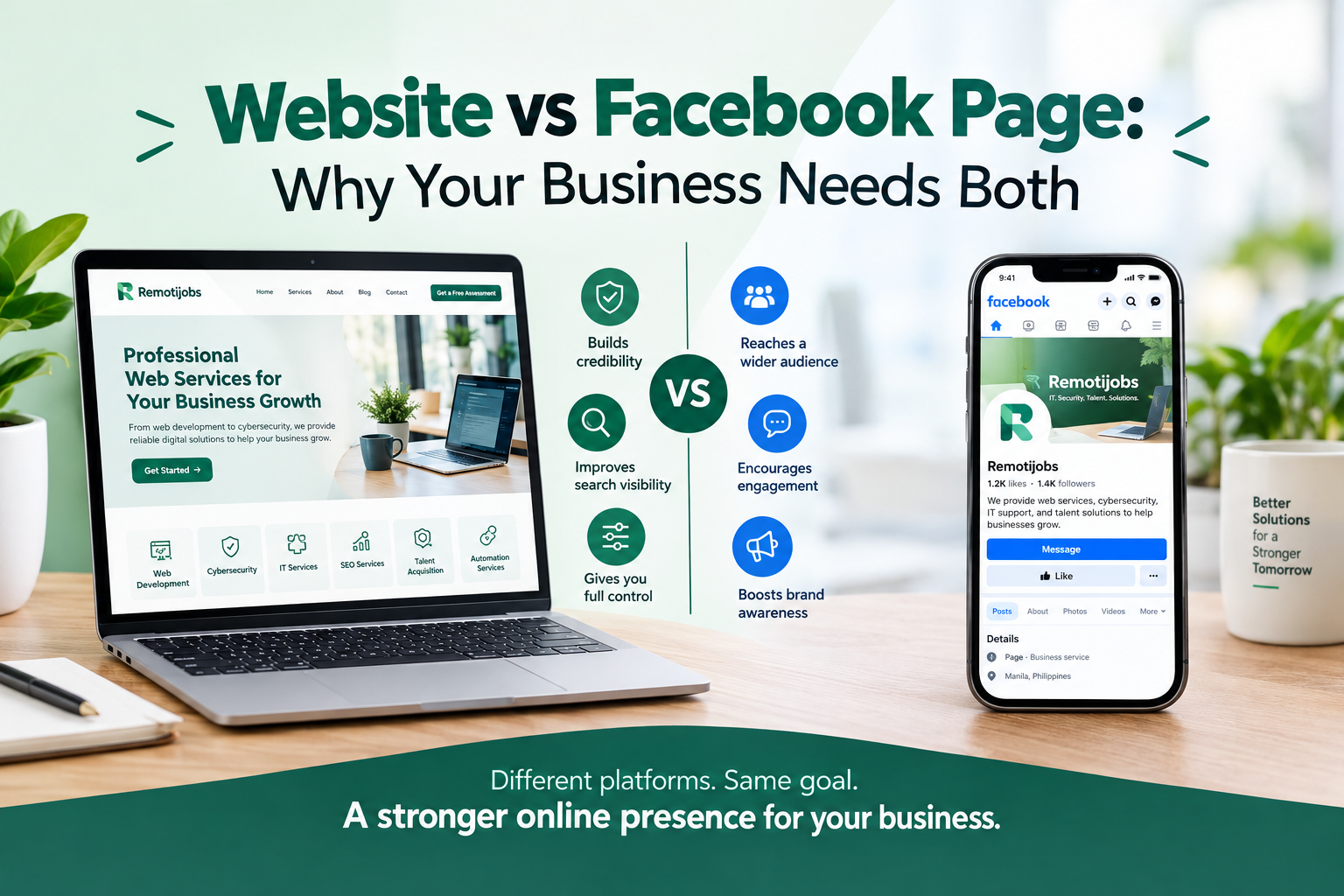
For many small businesses, Facebook is often the first place they establish an online presence. Creating a Facebook Page is easy, inexpensive, and gives businesses an immediate way to communicate with potential customers.
But as a business grows, an important question often comes up: Do I really need a website if I already have a Facebook Page?
The answer becomes clearer when you understand the difference between a website vs Facebook page.
A Facebook Page and a business website serve different purposes. Facebook can help you reach people, engage with your audience, and promote your products or services. A website gives your business a dedicated digital home where you control the content, customer experience, branding, and information you provide.
Rather than choosing between the two, businesses can benefit from using both a website and a Facebook Page as part of a broader digital strategy.
Website vs Facebook Page: What’s the Difference?
The biggest difference between a website and a Facebook Page is ownership and control.
Your business website is a digital property that you control. You decide what information appears on it, how it looks, what pages customers can visit, and how visitors interact with your business.
A Facebook Page, on the other hand, operates within Facebook’s platform.
Facebook provides businesses with tools for publishing posts, communicating with customers, running advertisements, collecting inquiries, and building an audience.
Both can be valuable, but they perform different roles.
| Feature | Business Website | Facebook Page |
|---|---|---|
| Branding control | High | Limited |
| Content control | High | Platform-dependent |
| Search engine visibility | Strong potential | Limited |
| Customer engagement | Available | Strong |
| Social sharing | Available | Excellent |
| Lead generation | Highly customizable | Available |
| Online credibility | Strong | Helpful |
| E-commerce capabilities | Flexible | Platform-dependent |
| Analytics | Extensive options | Built-in |
| Platform dependency | Low | High |
The important point is that a Facebook Page should complement your website rather than necessarily replace it.
Why Your Business Needs a Website
A website gives your business a dedicated place online where customers can learn about your company.
Instead of relying entirely on social media posts, you can organize important information into dedicated pages.
For example, a professional business website can include:
- Home page
- About Us
- Services
- Products
- Portfolio
- Blog
- Contact page
- Frequently Asked Questions
- Customer testimonials
- Booking or consultation forms
This creates a more structured experience for potential customers.
A Website Builds Your Brand
Your website allows you to control your business’s visual identity.
You can choose your:
- Colors
- Fonts
- Images
- Layout
- Messaging
- Navigation
- Calls to action
This can help create a consistent brand experience.
For a growing company, this is particularly important because customers may interact with the business through several channels before making an inquiry.
A Website Can Help Your Business Appear in Google Search
One of the major advantages when comparing a website vs Facebook page is search engine optimization.
A properly optimized website can target specific search terms that potential customers use when looking for products or services.
For example, a local business might create pages targeting searches such as:
- web development services
- IT support for small businesses
- cybersecurity services
- SEO services
- website design company
Businesses can also publish useful blog content to answer questions their potential customers are searching for.
This creates opportunities to attract organic search traffic.
A Facebook post may reach your existing followers, but a well-optimized website page can potentially continue attracting visitors through search engines long after it is published.
Why Your Business Still Needs a Facebook Page
Having a website doesn’t mean you should abandon Facebook.
Facebook remains useful for communication, community building, content distribution, and customer engagement.
A Facebook Page can help your business:
- Share company updates
- Publish promotional content
- Answer customer questions
- Receive messages
- Share photos and videos
- Promote blog articles
- Build an audience
- Run advertising campaigns
- Encourage social interaction
Social media is particularly useful because customers can interact with your business without necessarily visiting your website first.
Facebook Is Excellent for Reaching and Engaging Customers
Imagine your business publishes a helpful article about choosing the right cybersecurity solution for a small business.
Your website can host the complete article.
Your Facebook Page can then share the article with your audience.
This creates a simple customer journey:
Facebook → Website → Information → Contact → Potential Customer
Your website provides the deeper information, while Facebook helps distribute that information and encourage engagement.
This is one reason businesses should think about their website and social media presence as connected marketing channels rather than competing platforms.
What Happens If You Only Have a Facebook Page?
A Facebook-only presence can work for some very small businesses, especially when they are just starting.
However, relying exclusively on Facebook creates limitations.
H3: Your Business Depends on Another Platform
Your Facebook Page exists within Facebook’s ecosystem.
The platform controls its features, algorithms, policies, and user experience.
If Facebook changes how content is displayed, the way your audience sees your posts can change as well.
A website gives your business another digital channel that isn’t entirely dependent on a social media platform.
Your Information Can Be Harder to Organize
Important information can become buried beneath newer posts.
For example, if you publish your services today and continue posting regularly, customers may need to scroll through your Page to find older information.
A website allows you to create permanent pages for important information.
Your Business May Look Less Established
Customers often research a company before contacting it.
A professional website can provide a centralized location where visitors can see your services, company information, portfolio, FAQs, contact options, and other important details.
A Facebook Page can support that credibility, but it doesn’t necessarily provide the same level of control or structure.
What Happens If You Only Have a Website?
The opposite approach also has limitations.
A website can be an excellent foundation for your online presence, but simply creating a website doesn’t automatically bring customers to it.
You still need ways to attract visitors.
That’s where social media can help.
Facebook can provide a channel for sharing:
- New blog posts
- Promotions
- Company announcements
- Customer stories
- Videos
- Educational content
- Service updates
Your social media channels can therefore help drive traffic back to your website.
Website vs Facebook Page: Which One Should You Use?
Instead of thinking about this as an either-or decision, consider the role each platform plays.
Your website is your digital home.
Your Facebook Page is a channel for reaching and engaging people.
For example:
Website:
Provides detailed information about your business and services.
Facebook:
Shares that information with your audience.
Website:
Captures leads through forms and calls to action.
Facebook:
Starts conversations through posts and messages.
Website:
Supports long-term SEO.
Facebook:
Supports social engagement and content distribution.
Used together, they can create a stronger online presence.
How to Connect Your Website and Facebook Page
The most effective approach is to make the two platforms work together.
Start by linking your website from your Facebook Page.
Then include your Facebook Page on your website where appropriate.
You can also:
- Publish useful content on your website.
- Share that content on Facebook.
- Encourage Facebook followers to visit your website.
- Use your website to capture inquiries.
- Add clear calls to action.
- Track which channels generate website traffic.
- Continue improving both platforms based on customer behavior.
For example, a business could publish a blog titled “10 Signs Your Business Website Needs an Upgrade.“
The article lives on the website.
A shorter version can then be shared on Facebook with a link directing interested readers to the full article.
This creates a continuous connection between your website and social media presence.
Your Website and Facebook Page Serve Different Customer Needs
Customers don’t all discover businesses in the same way.
Someone may discover your company through a Facebook post.
Another person may search Google for a service.
Someone else may receive your website URL from a friend.
Another potential customer may see your business on social media and then visit your website before making contact.
Having multiple channels gives potential customers more ways to discover and research your business.
This is especially important as your company grows and your digital marketing becomes more sophisticated.
When Should a Small Business Get a Website?
If your business is currently operating only through Facebook, you don’t necessarily need to wait until you become a large company.
A website can become useful as soon as you need a more professional and organized place to present your business.
Consider creating a website if:
- Customers frequently ask for your website
- You want to appear in Google searches
- You offer multiple services
- You want to generate leads online
- You want greater control over your branding
- You want to publish SEO content
- You want to establish a stronger online presence
- You want to sell products or services online
- You want customers to book consultations
- You want to build a long-term digital marketing strategy
Website vs Facebook Page: The Bottom Line
The website vs Facebook page discussion doesn’t have to be about choosing one over the other.
Each platform serves a different purpose.
Your website gives your business a central digital home where you control your brand, content, customer experience, and lead-generation process.
Your Facebook Page gives you a social channel where you can communicate with customers, distribute content, build engagement, and reach potential buyers.
For many businesses, the strongest approach is to use both.
Think of your website as the foundation of your online presence and Facebook as one of the channels that helps people discover and interact with your business.
If you’re currently relying only on Facebook, building a professional website can be the next step toward creating a more complete digital presence.
And if you already have a website, connecting it with your social media channels can help you get more value from the content and resources you’ve already created.
Ready to Improve Your Business Website?
A website should do more than simply exist online. It should make it easier for potential customers to understand your business, find your services, trust your company, and take the next step.
Remotijobs helps businesses with web development, SEO, cybersecurity, IT services, content, talent acquisition, and automation.
If you’re unsure whether your current website is helping your business, you can start with a free website assessment to identify potential opportunities for improvement.