
If you are considering SEO for your business, one of the first questions you may have is: How long does SEO take to work?
Unlike paid advertising, SEO usually does not produce immediate and predictable results. You can launch an advertising campaign today and begin receiving traffic almost immediately, but organic search visibility typically develops over time.
For many businesses, SEO progress can become noticeable within the first few months. However, stronger and more competitive results can take six months, twelve months, or longer depending on the website, industry, competition, content, technical condition, and SEO strategy.
The important thing is to understand that SEO is not simply a waiting game. The work performed during those months matters.
How Long Does SEO Take to Show Results?
There is no single timeline that applies to every website.
A new business website with little authority and no existing search visibility will generally have a different starting point from an established website that has been publishing content and earning relevant links for years.
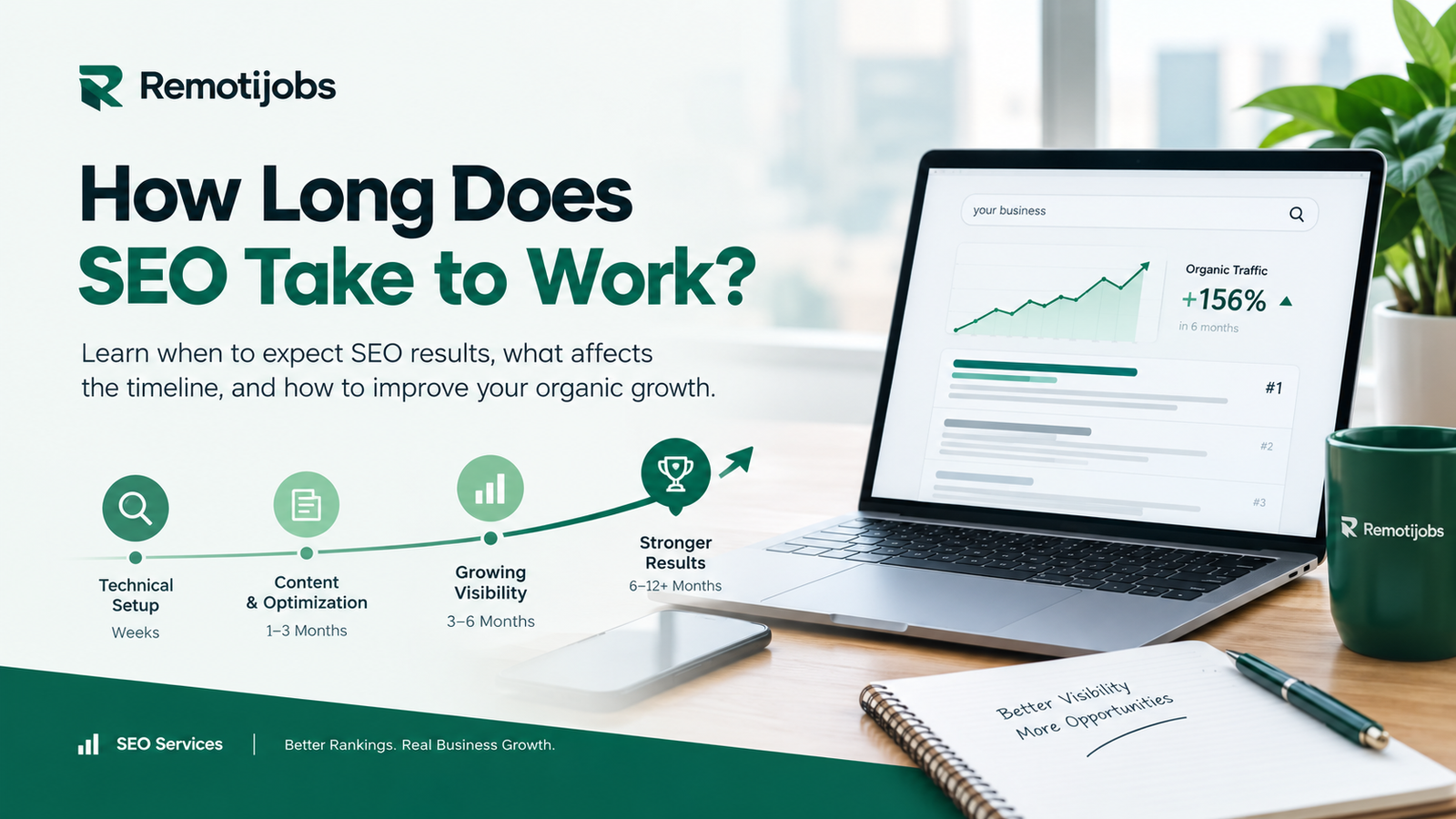
As a general guideline, businesses can think about SEO in several stages:
First few weeks: Technical issues, website structure, metadata, indexing problems, internal links, and other foundational issues can be identified and improved.
1–3 months: Search engines may begin reflecting changes from technical improvements, content optimization, and better site structure. Some pages may begin gaining impressions or improving for less competitive searches.
3–6 months: Consistent SEO work may begin producing more noticeable improvements in search visibility, keyword rankings, and organic traffic.
6–12+ months: A sustained SEO campaign may build stronger visibility for competitive topics as the website develops more relevant content, authority, and organic search history.
These are general guidelines, not guarantees. Some websites may see movement earlier, while highly competitive markets can require considerably more time.
Why Does SEO Take So Long?
SEO involves much more than adding keywords to a webpage.
Search engines need to discover and crawl pages, understand their content, determine their relevance, and decide how they compare with other pages competing for the same search.
A comprehensive SEO strategy may involve:
- Technical SEO
- Keyword research
- On-page optimization
- Content creation
- Internal linking
- Website performance
- User experience
- Local SEO
- Authority development
- Conversion optimization
Each area contributes to the overall health and visibility of a website.
For example, publishing a new article does not automatically place that article on the first page of Google. The page still needs to be discovered and evaluated, and it must compete with existing pages that may have stronger content and authority.
This is one reason SEO should be treated as an ongoing process rather than a one-time task.
What Happens During the First Few Months of SEO?
The early stage of an SEO campaign is often about building the foundation.
Before trying to rank for competitive keywords, it is important to make sure search engines can properly access and understand the website.
This may involve checking:
- Indexing
- Crawlability
- Page titles
- Meta descriptions
- Headings
- Internal links
- Broken links
- Website structure
- Mobile usability
- Page performance
- XML sitemaps
- Canonical URLs
- Duplicate content
Technical SEO is particularly important when a website has problems that prevent important pages from being properly discovered or understood.
If your website needs broader technical improvements, Remotijobs Web Development Services can complement an SEO strategy by addressing website structure, performance, functionality, and other development requirements.
Once the technical foundation is in place, SEO can focus more heavily on content, keyword targeting, internal linking, and authority building.
When Should You Expect to See SEO Results?
One of the biggest mistakes businesses make is looking only at rankings.
Rankings are important, but they are not the only indication that SEO is working.
A page moving from position 80 to position 40 may not generate significant traffic yet, but it can indicate that the page is gaining visibility.
Similarly, an increase in search impressions can show that Google is displaying your website for more relevant searches.
Businesses should monitor several SEO metrics, including:
Search impressions: How often your pages appear in search results.
Organic clicks: How many visitors arrive through unpaid search results.
Keyword rankings: Where your pages appear for target searches.
Organic traffic: The amount of traffic coming from search engines.
Click-through rate: The percentage of searchers who click your result after seeing it.
Conversions: The number of visitors who become leads, customers, or complete another valuable action.
Conversions are especially important for businesses.
The purpose of SEO is not simply to generate large numbers of visitors. The goal is to attract people who are relevant to the business and create opportunities for meaningful business results.
Why Some Websites Get SEO Results Faster
Several factors can influence how quickly SEO produces measurable progress.
1. Website Authority
A new website usually starts with less established authority than an older website with a history of publishing useful content and earning relevant links.
That does not mean a new website cannot rank. It means it may need more time and consistent work to establish its position within search results.
2. Keyword Competition
Competition has a major impact on SEO timelines.
A business attempting to rank for a broad keyword such as “web development” may be competing against established technology companies, agencies, directories, publishers, and other authoritative websites.
A more specific search may provide a different competitive environment.
Effective keyword research helps identify opportunities that are relevant to the business while taking competition and search intent into account.
3. Content Quality
Publishing dozens of articles does not automatically create a successful SEO strategy.
Content needs to provide useful information and satisfy the reason behind the search.
For an informational query, the content should answer the user’s question clearly.
For a commercial search, users may want to understand services, pricing, capabilities, processes, experience, or available solutions.
The better the content matches the searcher’s intent, the more useful the page can become.
4. Technical SEO
Technical problems can limit organic performance.
For example, important pages may not be indexed properly, internal links may be weak, pages may load slowly, or the site’s structure may make it difficult for search engines to understand the relationship between different pages.
Technical SEO should therefore be reviewed alongside content and keyword strategy.
5. Website Security
Security is not a replacement for SEO, but it is an important part of maintaining a professional and trustworthy website.
Businesses should monitor issues such as outdated software, vulnerable plugins, insecure configurations, and other website security risks.
For businesses that need both search visibility and website protection, Remotijobs Cybersecurity Services can be incorporated into the broader website improvement process.
Does SEO Work Immediately?
Some SEO changes can produce relatively quick improvements, but this should not be confused with immediate ranking success.
For example, fixing an indexing problem could allow a page that was previously unavailable to search engines to become eligible for indexing.
Improving a page title could also improve how the page is presented in search results.
However, these individual improvements do not guarantee a first-page ranking.
Competitive organic visibility usually requires multiple improvements working together.
SEO is cumulative.
Technical improvements create a stronger foundation. Content expands the topics a website can be discovered for. Internal links help connect related pages. Authority development can strengthen the site’s ability to compete. Continuous optimization allows the strategy to improve based on actual performance.
Can You Make SEO Work Faster?
There is no legitimate shortcut that guarantees first-page rankings.
However, businesses can make SEO more efficient by focusing on the areas that are most likely to affect performance.
Start with a technical SEO audit.
Before producing hundreds of articles, determine whether there are technical problems that could prevent existing and future content from performing properly.
Next, research keywords based on what your potential customers actually search for.
Instead of targeting only extremely competitive keywords, build a broader keyword strategy that includes specific, relevant searches.
Then create genuinely useful content around those topics.
Existing pages should also be reviewed regularly. Sometimes improving a page that already has impressions and rankings can be more productive than continuously publishing new content.
Internal linking should also be considered.
For example, an article about SEO timelines can naturally link to a company’s SEO services page. An article about website performance can link to web development services. Security-related content can connect to cybersecurity services.
This creates a clearer relationship between informational content and commercial service pages.
How Long Should You Invest in SEO?
SEO is generally more effective when treated as an ongoing marketing channel rather than a one-time project.
A business may complete an initial technical optimization project, but search behavior, competitors, content, and search results continue to change.
That means SEO needs ongoing attention.
A long-term SEO strategy can include:
- Technical SEO monitoring
- Keyword research
- New content creation
- Existing-content optimization
- Internal linking
- Local SEO
- Authority development
- Conversion optimization
- Performance tracking
The objective is not simply to achieve one ranking.
The objective is to build an organic search presence that can continue generating relevant traffic and business opportunities.
How Can You Tell If Your SEO Strategy Is Working?
A useful SEO report should show more than a list of keyword positions.
Look for trends over time.
Are search impressions increasing?
Are more pages appearing in search results?
Are important keywords moving upward?
Is organic traffic increasing?
Are visitors reaching important service pages?
Are organic visitors submitting forms, requesting information, or becoming customers?
These questions provide a much better picture of SEO performance than focusing on a single keyword.
It is also important to understand that rankings can fluctuate.
A temporary ranking drop does not necessarily mean an SEO campaign has failed. Search results change, competitors publish new content, websites are updated, and search engines continuously adjust how results are displayed.
The broader trend is usually more meaningful than one day’s ranking.
When Should a Business Start SEO?
If organic search is an important source of potential customers, it is generally better to start building SEO visibility sooner rather than waiting until the website needs traffic immediately.
SEO requires time because authority, content, relevance, and visibility are developed progressively.
Waiting until you urgently need organic traffic can put a business in a difficult position.
Starting earlier gives a website more time to build its content foundation and establish visibility for relevant searches.
Start With an SEO and Website Assessment
If you are unsure why your website is not generating more organic visibility, the first step should not necessarily be purchasing a large SEO campaign.
Start by understanding what is currently happening.
A website assessment can identify potential issues involving SEO, content, technical performance, website structure, and security.
Remotijobs offers a Free Website Growth & Security Assessment for businesses that want an initial look at areas that may be limiting their website’s performance.
The assessment can help identify opportunities before deciding what SEO or website improvements should be prioritized.
SEO Is a Long-Term Investment
So, how long does SEO take to work?
There is no universal number of days or months that guarantees results.
For many businesses, SEO should be viewed in terms of months rather than days. Early improvements may become visible within the first few months, while stronger organic growth can take six months, twelve months, or longer depending on the website, competition, industry, content, authority, and quality of implementation.
The most important question is not simply how long you wait.
It is what happens during that time.
A website that continuously improves its technical foundation, creates useful content, targets relevant search terms, strengthens its internal structure, develops authority, and measures actual business results has a stronger foundation for sustainable organic search growth.
SEO is therefore not a quick fix.
It is a long-term process of making a website more useful, more discoverable, and more valuable to the people searching for what a business offers.
If you want to understand where your website currently stands before investing in SEO, start with a Free Website Growth & Security Assessment from Remotijobs.