
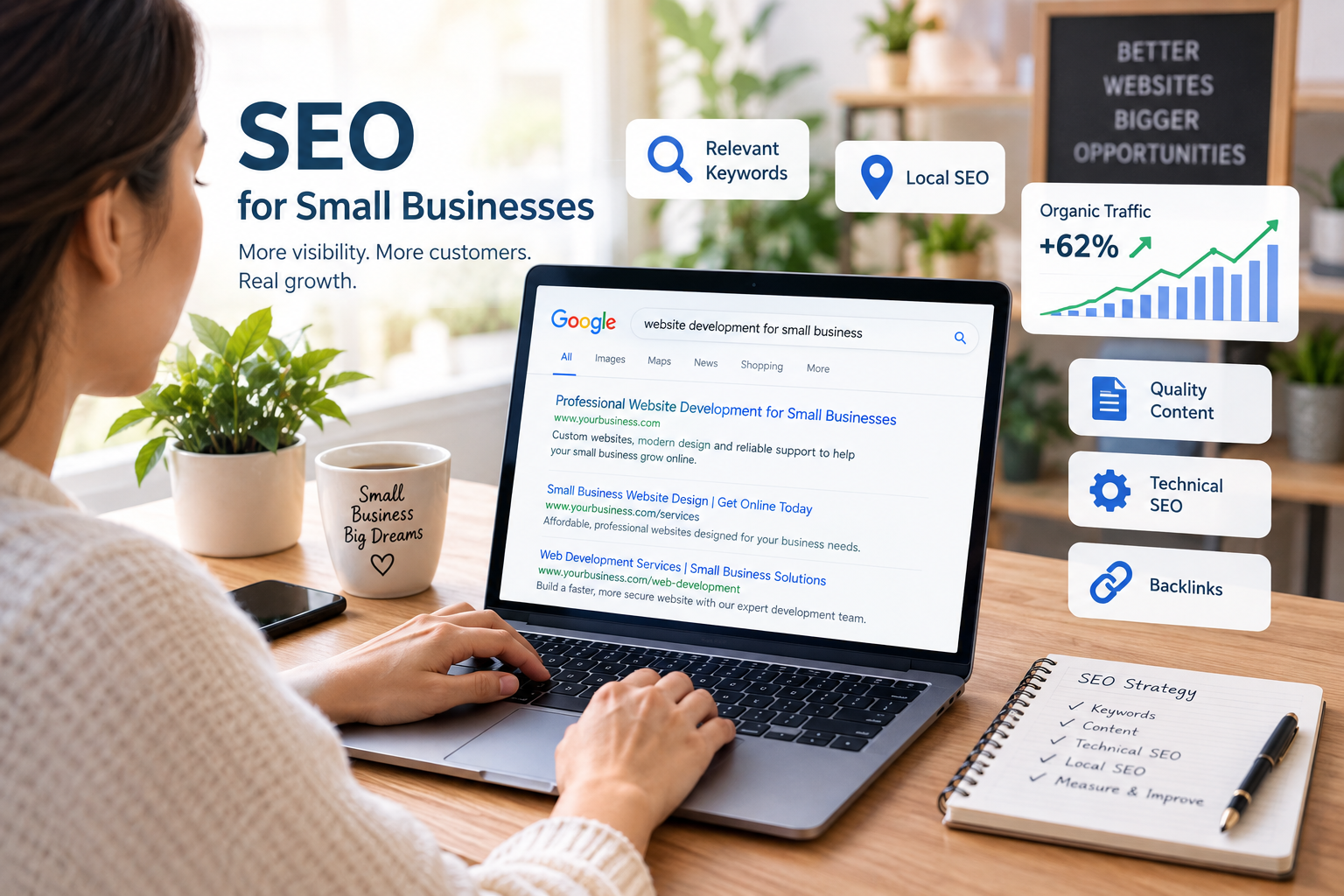
For many small businesses, getting found online can be challenging. You may have a professional website, excellent products or services, and satisfied customers, but if potential customers cannot find you in search results, your website may not generate the opportunities you expect.
This is where SEO for small businesses becomes important.
Search engine optimization, commonly called SEO, is the process of improving your website and online presence so search engines can better understand your business and show your pages to people searching for relevant products, services, and information.
For a small business, SEO does not have to mean complicated technical work or trying to rank for every possible keyword. A practical SEO strategy starts with understanding your customers, creating useful content, optimizing your website, improving technical performance, and making it easier for search engines to understand what your business offers.
This guide explains the fundamentals of small business SEO and how you can start improving your website’s visibility.
What Is SEO for Small Businesses?
SEO for small businesses is the process of improving a company’s website and online presence so it has a better opportunity to appear in relevant search results.
The objective is not simply to get more website visitors. The more important goal is to attract relevant visitors who are genuinely interested in what your business provides.
For example, a local web development company might want to be discovered when someone searches for “website development company,” “small business website design,” or “website redesign services.”
A local accounting firm may target searches such as “accountant near me,” “small business accountant,” or “bookkeeping services.”
The right SEO strategy depends on the business, its customers, location, competition, and services.
Why SEO Matters for Small Businesses
Search engines are an important part of how people research businesses today. Before contacting a company, potential customers may search for its services, compare different providers, read reviews, visit websites, and look for answers to specific questions.
A strong search presence can help your business become visible during that research process.
SEO can also provide a long-term source of website traffic. Unlike paid advertising, where traffic generally stops when the advertising campaign ends, a well-optimized page can continue attracting organic visitors over time.
However, SEO should not be viewed as a shortcut to instant results.
Building organic visibility takes time. Your results can depend on competition, search demand, website quality, content, technical SEO, authority, location, and how consistently you improve your online presence.
Start With Keyword Research
Keyword research is one of the foundations of SEO.
Keywords are the words and phrases people enter into search engines. For a small business, researching these searches can reveal what potential customers are actually looking for.
For example, a web development company might research terms such as “business website development,” “website redesign,” “WordPress website development,” or “website development for small businesses.”
But search volume should not be the only consideration.
You also need to understand search intent.
Someone searching for “what is SEO” is probably looking for information. Someone searching for “SEO services for small businesses” may be researching professional services. A person searching for “SEO company near me” may be looking for a provider.
Creating content that matches the intent behind the search gives your pages a better chance of being useful to the people who discover them.
Understand Search Intent
Search intent describes the reason behind a search. Understanding intent helps you decide whether a search should be targeted with a blog article, service page, location page, product page, or another type of content.
Optimize Your Website Pages
Once you understand the searches relevant to your business, the next step is optimizing your website.
Your most important pages should clearly explain what your business does, what services you provide, who you serve, and where you operate.
Page titles, headings, URLs, meta descriptions, and page content should accurately describe the subject of each page.
For example, a page simply titled “Services” provides very little context. A title such as “SEO Services for Small Businesses” gives both users and search engines a much clearer indication of what the page is about.
Your website content should also be written for people first. Keywords should appear naturally rather than being repeatedly inserted into sentences simply to influence rankings.
Page Titles
Use clear, descriptive page titles that accurately communicate the main topic and align with the search intent you are targeting.
Meta Descriptions
Write concise, relevant meta descriptions that summarize the page and encourage qualified searchers to click.
Headings and URLs
Use logical headings and short, descriptive URLs so both visitors and search engines can understand your page structure.
Website Content
Create original, useful content that answers the visitor’s needs rather than writing primarily for search engines.
Create Useful Content
Content is an important part of a small business SEO strategy.
Your potential customers have questions. Those questions can become opportunities to create useful articles that attract people through search engines.
For example, a web development company could publish articles about website costs, website redesigns, website security, SEO, website maintenance, and choosing a website development company.
These articles can attract people earlier in the buying journey and introduce them to your business.
However, publishing dozens of low-quality articles is not necessarily an effective strategy.
A better approach is to create content that genuinely answers questions your target customers have.
Ask yourself whether an article provides useful information, addresses a real problem, demonstrates your knowledge, and gives the reader a logical next step.
That final point is particularly important.
Your blog should not exist completely separately from your services. When appropriate, useful articles should connect readers to relevant service pages.
For example, an article about improving website rankings can naturally direct readers toward your SEO Services. An article about website security can introduce your Cybersecurity Services, while an article about redesigning an outdated website can link to your Web Development Services.
Use Internal Links
Internal links connect pages on your website.
They make it easier for visitors to discover related information and help search engines understand the relationships between different pages on your website.
For example, this article about small business SEO could link to your SEO service page. A website redesign article could link to your web development service. A cybersecurity article could link to your security assessment service.
A well-planned internal linking structure helps turn individual blog posts into part of a larger website ecosystem.
Don’t Ignore Local SEO
If your business serves customers in a particular city, region, or service area, local SEO can be especially important.
When people search for businesses nearby, search engines may display local business results alongside traditional organic listings.
Your business information should therefore be accurate and consistent across relevant online platforms.
Your website should also clearly communicate where you operate and what services you provide.
For example, a business serving Manila should make its location and service information clear rather than expecting search engines to determine its geographic focus automatically.
Local SEO is not just about adding a city name to every page. Your website should provide genuinely useful information for the customers and locations you serve.
Improve Your Technical SEO
Technical SEO focuses on the parts of your website that affect crawling, indexing, performance, and usability.
For a small business, the fundamentals are often the best place to start.
Your website should work properly on mobile devices, use HTTPS, load efficiently, have logical navigation, and allow search engines to access important pages.
You should also check for broken links, indexing problems, unnecessary redirects, poor page structures, and other technical issues that could prevent search engines or visitors from accessing your content effectively.
Website speed is another important consideration. Large images, unnecessary scripts, poorly optimized plugins, and inefficient website configurations can contribute to slow loading times.
Technical SEO can become highly advanced, but you do not need to solve every technical issue simultaneously. Start by identifying the problems that have the greatest impact on your users and search visibility.
Mobile Friendliness
Make sure your website is easy to use on smartphones and tablets, with readable text, usable navigation, and layouts that adapt to smaller screens.
Website Speed
Review image sizes, scripts, plugins, hosting, caching, and other factors that may affect loading performance.
HTTPS and Security
Use HTTPS and maintain a secure website configuration to protect visitors and support trust.
Crawlability and Indexing
Make sure important pages can be discovered and indexed while pages that should not appear in search are handled appropriately.
Optimize Your Images
Images can improve a website’s design and make content easier to understand, but poorly optimized images can also slow down your website.
Use appropriately sized and compressed images whenever possible.
Descriptive filenames can also provide useful context. Instead of uploading an image named “IMG12345.jpg”, a business could use a descriptive filename such as “small-business-seo-strategy.jpg”.
Alternative text should also be used appropriately to describe meaningful images, particularly for accessibility.
Build Content Around Topics
Instead of creating one page for every keyword variation, small businesses can build content around broader topics.
For example, a cybersecurity company could create a main page about website security services and supporting content covering common website security risks, WordPress security, website security assessments, and ways businesses can protect their websites.
These related pages can link to each other and to the main service page.
This approach creates a more useful resource for visitors while helping search engines understand the subject areas your website covers.
Build Relevant Authority
Links from other websites can also contribute to your website’s search presence.
A backlink occurs when another website links to your website.
For small businesses, relevant links may come from industry organizations, professional associations, local business directories, partners, publications, or useful resources.
The goal should not simply be to collect as many links as possible.
A relevant mention from a trustworthy website can be more meaningful than a large number of low-quality links.
Small businesses can also earn attention by publishing original research, creating useful resources, participating in industry communities, and developing relationships with relevant organizations.
Measure Your SEO Results
SEO should be measured rather than treated as a guessing game.
Tools such as Google Search Console can help you understand how your website appears in search results, while analytics platforms can provide information about website visitors and conversions.
Look beyond traffic alone.
A page that receives hundreds of visitors but generates no inquiries may not be as valuable to a small business as a page that attracts fewer but highly relevant visitors who contact the company.
Depending on your goals, useful measurements can include organic traffic, search impressions, clicks, search queries, conversions, contact form submissions, phone calls, and qualified leads.
The ultimate question should be:
Is SEO helping the business reach the right people?
Look Beyond Website Traffic
Traffic is useful, but relevance matters. Evaluate whether organic visitors are engaging with your content and taking meaningful actions.
Track Leads and Conversions
Connect SEO performance to contact forms, calls, consultations, assessments, and other business outcomes whenever possible.
Common SEO Mistakes Small Businesses Should Avoid
One common mistake is trying to rank for extremely competitive keywords without considering whether the business has the authority or resources to compete.
Another is keyword stuffing. Repeating the same phrase unnecessarily can make content difficult to read and does not create a better experience for visitors.
Some businesses also publish large amounts of low-quality content without considering whether the information is genuinely useful.
Technical issues are another common problem. A website may have good content but still perform poorly because important pages cannot be crawled, the site is difficult to use on mobile devices, or pages load slowly.
Finally, many businesses expect SEO to produce immediate results.
SEO is generally a long-term process. Building useful content, improving technical performance, developing authority, and establishing search visibility takes time.
A Practical SEO Strategy for Small Businesses
If your business is starting SEO from scratch, keep the process manageable.
Begin by identifying your target customers and researching the searches they are likely to use. Review your homepage and service pages to make sure they clearly communicate what you offer.
Next, identify technical problems that may affect your website’s performance or search visibility.
Then build useful content around the questions your potential customers are asking.
As your content grows, connect relevant articles to your service pages through internal links.
If you serve a particular geographic area, make local SEO part of your strategy.
Finally, measure your results and use the data to determine which pages and topics deserve further attention.
SEO works best as an ongoing process rather than a one-time project.
Start With a Free Website Growth & Security Assessment
Not sure where your website currently stands?
Before investing in a major SEO campaign, it can be useful to identify the existing problems and opportunities on your website.
Remotijobs offers a Free Website Growth & Security Assessment designed to help businesses identify potential areas for improvement across their website.
The assessment can help uncover opportunities related to SEO, website performance, user experience, and security.
Instead of guessing what needs to be fixed, you can start by understanding where your website currently has room for improvement.
Request your free website assessment: https://remotijobs.com/free-website-assessment/
How Long Does SEO Take for a Small Business?
There is no universal timeline for SEO.
A newer website in a competitive industry may require significant time and effort to establish visibility, while a website with an existing presence may have opportunities that can be addressed more quickly.
Results can depend on the competitiveness of your keywords, website authority, content quality, technical condition, location, industry, and the consistency of your SEO efforts.
This is why businesses should be cautious about anyone promising immediate or guaranteed rankings.
SEO is better approached as a continuous investment in your website’s visibility and usefulness.
Should Your Small Business Invest in SEO?
For businesses that rely on online discovery, SEO can become an important part of a broader digital marketing strategy.
The objective should not simply be to rank number one for a particular keyword.
Instead, focus on building a website that answers customer questions, clearly communicates your services, provides a good user experience, and is technically accessible to search engines.
A practical SEO strategy brings these elements together:
Understand your customers → research their searches → optimize your website → create useful content → improve technical SEO → strengthen local visibility → measure results → keep improving.
For small businesses, starting with the fundamentals is often the most practical approach.
If you are unsure where to begin, a Free Website Growth & Security Assessment from Remotijobs can provide a starting point for identifying SEO, performance, website, and security opportunities.
Your website does not need to be perfect before you start improving it. What matters is having a clear understanding of where you are today and what you can improve next.